

The popular advice to take taurine for an energy boost skips the most important question: what kind of energy do you mean? Feeling more awake, sustaining a hard cycling effort, and supplying muscles with fuel aren't interchangeable outcomes. An ingredient can plausibly support one without delivering the others.
That distinction matters when you're choosing between a standalone supplement and an energy drink. The useful question isn't whether taurine appears in products marketed for energy. It's whether taurine itself improves the outcome you care about, at a dose and under conditions that resemble your routine.
Table of Contents
- Whether Taurine Itself Delivers Energy
- How Taurine Supports Energy Production in Muscles
- What Exercise Trials Show for Endurance and Performance
- Dosing Ranges Studied and What They Mean
- Safety Limits and Who Should Be Cautious
- Food Sources and Energy Drink Exposure Compared
- Deciding Whether Taurine Fits Your Routine
Whether Taurine Itself Delivers Energy
Taurine alone isn't a caffeine-like stimulant. Its presence in an energy drink doesn't establish that it produces the quick lift you feel after drinking it. The regulatory discussion has historically centered on exposure and safety, rather than demonstrating a standalone stimulant effect, as illustrated by the European Commission Scientific Committee review.
A response to a multi-ingredient beverage can't identify which ingredient caused it. If caffeine is present, there's already a well-established stimulant explanation for increased alertness.
Taurine, caffeine and the combination compared
A 2025 systematic review and network meta-analysis of 12 studies found that caffeine plus taurine improved anaerobic capacity and reaction time versus either ingredient alone, while taurine alone showed only a possible, statistically uncertain reduction in blood lactate.
| Option | Reported effect in trials | Stimulant effect |
|---|---|---|
| Taurine alone | Possible but statistically uncertain reduction in blood lactate | Not established |
| Caffeine alone | Lower anaerobic-capacity and reaction-time results than the combination in the review's comparisons | Yes, the main stimulant |
| Caffeine plus taurine | Improved anaerobic capacity and reaction time versus either ingredient alone | Yes, driven by caffeine |
The review also reported inconsistent endurance and physiological outcomes. That doesn't support a broad promise of better daytime energy, nor does an uncertain lactate result demonstrate that someone will feel less tired.
The reaction-time and anaerobic findings belong to the combination. They aren't proof that taurine alone improves short maximal efforts. Equally, better results with the combination don't establish that every energy drink has an effective formulation.
Label-reading rule: If a taurine product also contains caffeine, don't credit the immediate lift to taurine.
Perceived alertness is a subjective experience. Physical capacity is the ability to complete or sustain a task. Confusing them makes a supplement sound more versatile than its evidence allows.
For a wider explanation of that distinction, our guide to whether amino acids give you energy helps separate metabolic support from stimulation. If your goal is stimulant-free daytime alertness, taurine alone is a weak option, not a demonstrated replacement for caffeine or sleep.
How Taurine Supports Energy Production in Muscles
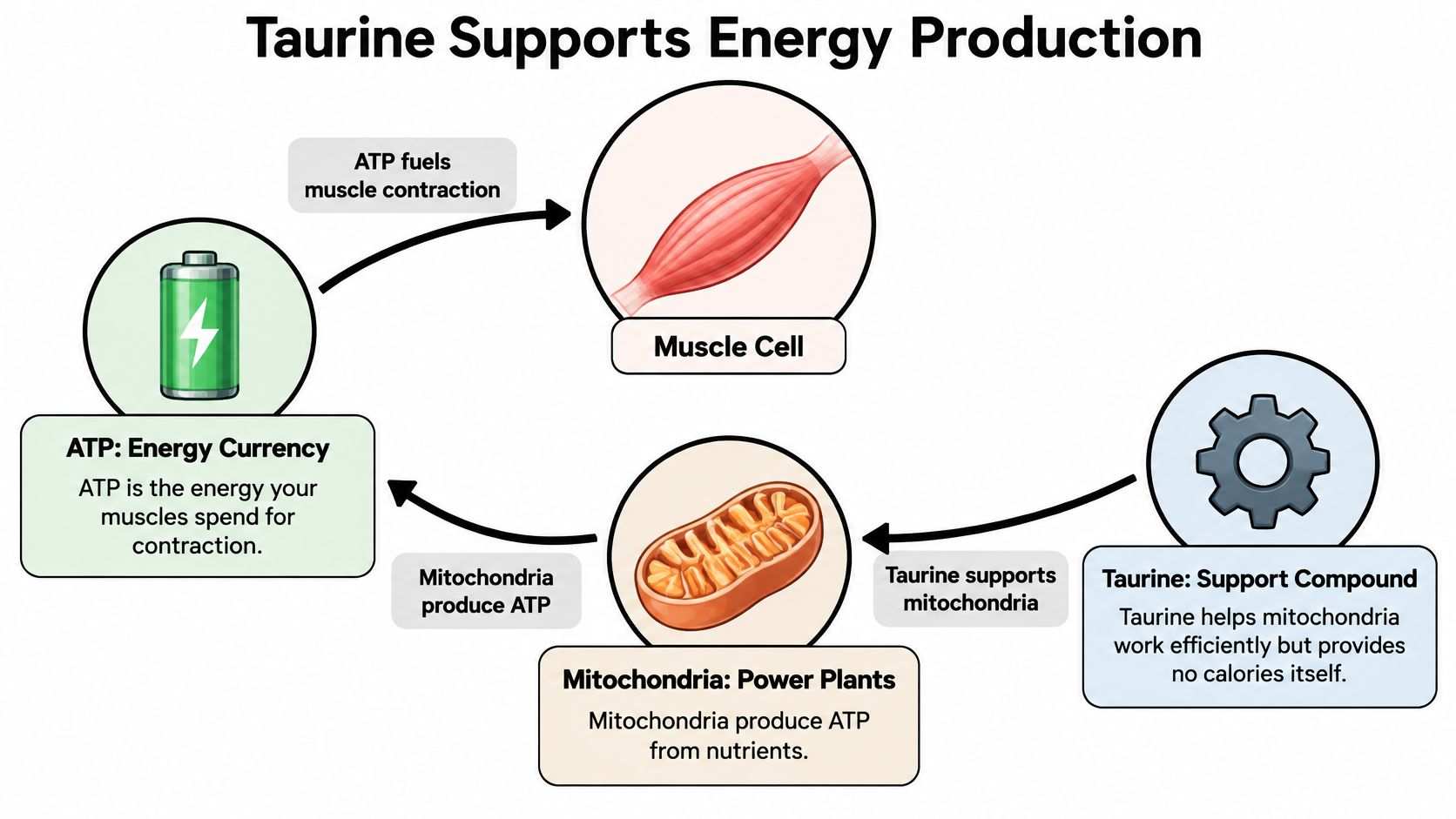
Consider a cyclist maintaining a demanding pace. Their muscles repeatedly spend adenosine triphosphate, or ATP, to contract. Think of ATP as spendable energy currency and mitochondria as the power plants that help replenish it from nutrients.
Taurine fits into that picture as a support compound, not another tank of fuel. It isn't interchangeable with the carbohydrate in a meal or sports drink. The relevant hypothesis concerns how muscle cells maintain energy production during demanding activity, not whether swallowing taurine supplies an immediate burst of usable fuel.
The concept map below illustrates that proposed relationship, rather than a guaranteed effect of supplementation.
A plausible mechanism isn't a proven benefit
Proposed mechanisms include stabilizing the mitochondrial matrix, improving metabolic efficiency, and limiting oxidative stress. Together, these could help preserve ATP production during prolonged exertion. However, those explanations remain partly inferential in healthy humans.
That qualification changes how you should interpret the diagram. An arrow from taurine to mitochondrial function represents a biological rationale. It doesn't show that an otherwise healthy person will experience more energy after adding a supplement.
- Mitochondrial support: The proposed benefit concerns maintaining energy-producing machinery, not creating fuel from nothing.
- Oxidative balance: A possible protective effect during exertion doesn't establish a noticeable improvement at rest.
- ATP availability: Preserving production during stress is different from increasing maximum power or subjective wakefulness.
For the cyclist, the relevant outcome would be maintaining the prescribed effort longer under comparable conditions. Feeling a buzz before getting on the bike wouldn't test the proposed mechanism.
Taurine may support the system that makes energy available. That isn't the same as supplying fuel or stimulating alertness.
This distinction also prevents an unjustified leap from cellular biology to daily fatigue treatment. Even a convincing mechanism needs human performance results before it becomes a useful supplement recommendation.
What Exercise Trials Show for Endurance and Performance
The strongest endurance signal is small to moderate, not dramatic. An Alzheimer's Drug Discovery Foundation scientific review.pdf) summarizes a meta-analysis of 10 clinical trials using 1–6 g per day, reporting improved endurance performance (Hedges' g = 0.40; p = 0.004) and time to exhaustion (Hedges' g = 0.43; p = 0.007), alongside a randomized crossover study in 17 young men in which a single 6 g dose didn't significantly improve high-intensity running time to exhaustion or maximal accumulated oxygen deficit.
Hedges' g expresses the difference between treatment and comparison conditions relative to the variability in the results. It isn't a percentage improvement. You can't translate it directly into minutes saved, distance covered, or a faster race finish.
Key exercise trial results for taurine
The results summarized in that review show both the pooled positive signal and the individual null finding.
| Evidence | Dose | Result |
|---|---|---|
| Meta-analysis of 10 clinical trials, endurance performance | 1–6 g per day | Significant improvement, Hedges' g = 0.40; p = 0.004 |
| Meta-analysis of 10 clinical trials, time to exhaustion | 1–6 g per day | Significant improvement, Hedges' g = 0.43; p = 0.007 |
| Randomized crossover study, 17 young men | Single 6 g dose | No significant improvement in high-intensity running time to exhaustion or maximal accumulated oxygen deficit |
The null result deserves its full weight. A substantial acute dose didn't reliably improve those running outcomes. It shouldn't be softened into a claim that everyone benefits if they take enough.
Why a pooled benefit doesn't predict your workout
Trials can ask different questions even when they test the same ingredient. Sustaining a fixed workload until exhaustion isn't the same task as completing a race distance quickly, and neither is equivalent to producing a brief maximal burst.
Training status, exercise intensity, protocol design, and individual response can all affect the outcome. Pooling studies helps identify an overall pattern, but it doesn't erase those differences or establish a universal responder profile.
For athletes comparing supplements for endurance, the appropriate question is whether the tested task resembles their training goal. A laboratory improvement in tolerance may be relevant, but it doesn't automatically predict a personal best.
The defensible positioning is potential support for sustained exercise capacity. These findings don't establish a dependable benefit for short maximal efforts, and they don't justify advertising taurine as an immediate pre-workout jolt.
Dosing Ranges Studied and What They Mean
For a hypothetical 70 kg adult, a weight-based protocol can look quite different from the amount in a single beverage. A controlled critical-power study used 50 mg/kg before exercise, equivalent to approximately 3.5 g at that body weight, and increased time to exhaustion at 5% above critical power to 17.7 minutes versus 16.0 minutes with placebo, approximately 1.7 minutes longer.
End-power output wasn't significantly different between conditions. The distinction is practical: participants sustained a demanding task longer, but the intervention didn't establish greater maximum output.
Taurine doses and durations in the research
The table separates that critical-power protocol from the broader dosing and safety ranges summarized in the cardiovascular review discussed under safety. These are research exposures, not interchangeable recommendations.
| Dose or duration | Where it was studied | What the evidence shows |
|---|---|---|
| 1–4 g per day | Acute exercise studies | Range reported in acute exercise studies |
| 14–100 mg/kg body weight | Acute exercise studies | About 1 g to 7 g for a 70 kg adult |
| 50 mg/kg before exercise | Critical-power study | About 3.5 g for 70 kg; time to exhaustion 17.7 versus 16.0 minutes |
| 1.5–6 g per day | Controlled trials | Range studied across controlled trials |
| About 3 g per day | Proposed observed safety level | Proposed in some research, not a recommended target |
| 5–10 g per day | Reported dose level | Mild cramps or fatigue reported at this level |
| 7 days to 8 weeks | Chronic trials | Conducted only in healthy adult males |
A weight-based range shouldn't become a self-prescribing calculator. Its upper end describes an exposure researchers investigated, not an amount every adult should take. Similarly, an observed safety level doesn't identify the most effective performance dose.
Match the protocol, not the marketing
There's no universal taurine dose for energy. Before considering an amount, identify the intended outcome, the studied population, whether supplementation was acute or repeated, and whether the product contains other active ingredients.
- Avoid stacking: Count taurine from powders, capsules, pre-workouts, and drinks together.
- Don't chase the highest dose: A larger exposure doesn't establish a larger benefit.
- Treat timing cautiously: The study description supports taking it before exercise, but doesn't establish a standard timing window for everyone.
If a clinician agrees that a trial is appropriate, discuss a conservative amount rather than treating the full experimental range as a target. Don't change the dose, caffeine intake, and training plan simultaneously if you want an interpretable result.
The useful lesson from the critical-power experiment is specific: exercise tolerance may improve without an increase in power. Protocol, intensity, training status, and individual response still determine whether that finding is relevant to you.
Safety Limits and Who Should Be Cautious
Small, short trials can't establish safety for everyone. The absence of serious adverse effects in selected participants is reassuring within that setting, but it isn't proof of suitability during pregnancy, adolescence, chronic illness, or medication use.
Pregnancy is a particularly important reason not to extrapolate from athletic supplementation studies.

A 2025 cardiovascular review summarizes the dose ranges and durations tabulated above and notes that taurine and other energy-drink ingredients may potentiate caffeine-related hemodynamic changes. Its chronic exercise evidence comes from healthy adult males, limiting conclusions for other populations.
Who should seek individual advice
The evidence doesn't adequately establish safety for pregnant people, adolescents, people with kidney or liver disease, or people taking medications. These are evidence gaps, not a claim that taurine necessarily harms everyone in those groups.
Anyone with a heart condition, taking blood-pressure medication, or managing a condition sensitive to stimulants should consult a clinician before using taurine-containing energy products. Bring the complete ingredient label, not just the product name.
- Standalone taurine: Assess the supplement amount and your medical circumstances.
- Energy drinks: Assess caffeine and the rest of the formulation as well.
- Alcohol or demanding exercise: Don't assume that tolerance of individual ingredients establishes safety under combined stress.
Interactions involving caffeine, alcohol, exercise, and dehydration haven't been fully characterized. That uncertainty is a reason to avoid experimenting with a new energy formulation during a strenuous event or alongside alcohol.
For additional viewing alongside the written evidence, the video below offers another format for considering taurine.
Know when to stop
Heart palpitations, chest discomfort, persistent cramps, or unusual fatigue warrant stopping the product and seeking medical advice. Chest discomfort, especially with breathlessness, fainting, or severe symptoms, calls for urgent assessment rather than another attempt at a lower dose.
Don't assume taurine is the culprit if a blended product causes symptoms. Equally, don't assume caffeine explains everything and continue using the blend.
A measured interpretation is that taurine has generally been tolerated in studied settings, while the evidence leaves important population and long-term questions unanswered. Generally tolerated isn't the same as appropriate for every person or every combination.
Food Sources and Energy Drink Exposure Compared
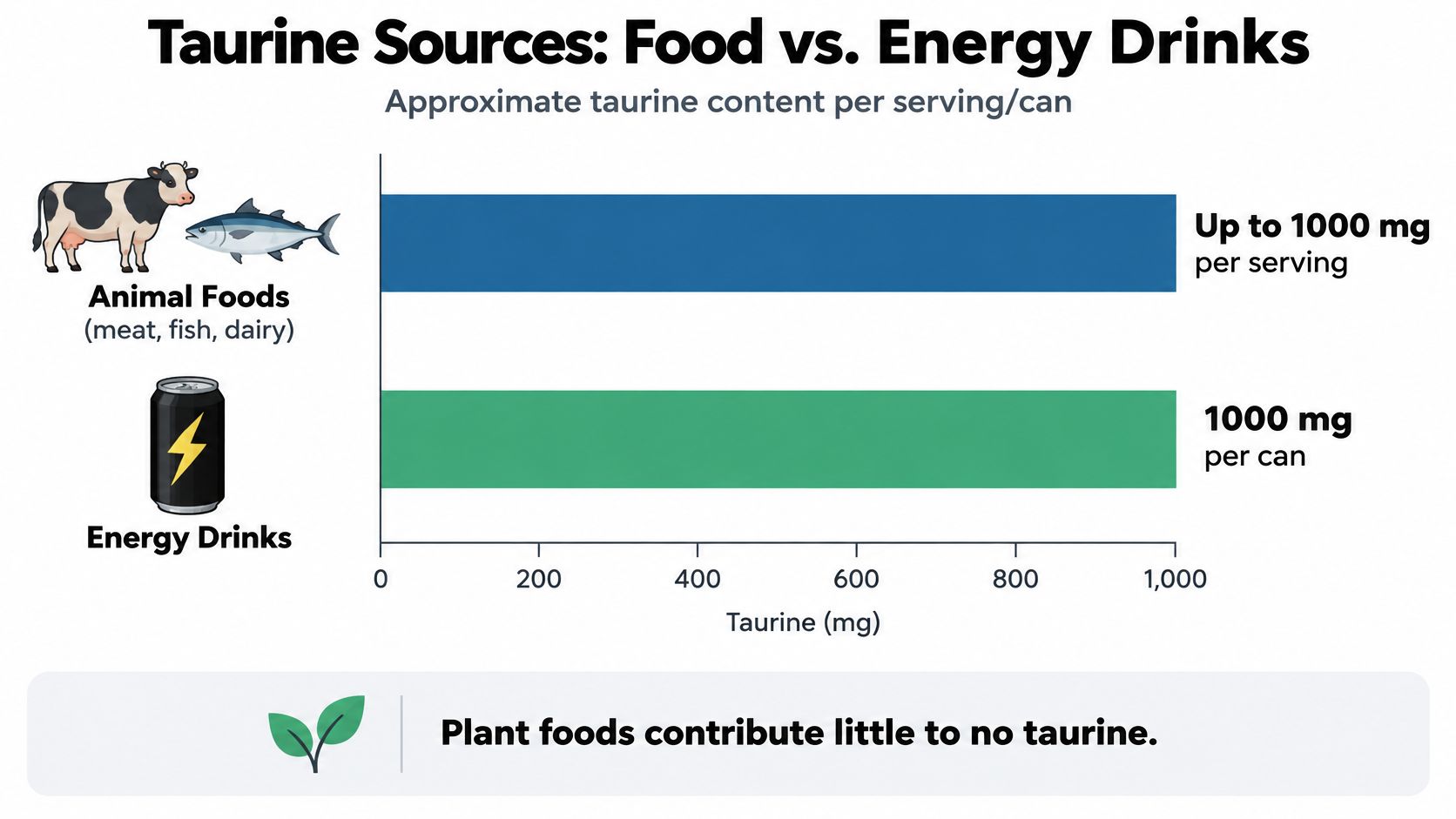
Taurine occurs mainly in animal foods, including meat, fish, and dairy, while plant foods contribute little. That difference matters when reviewing a vegetarian or vegan diet, but lower dietary exposure alone doesn't establish a need for an energy supplement.
A European food-safety assessment provides the comparison below: approximately 400 mg per day from naturally occurring dietary sources, typical commercial servings supplying 750–1,000 mg, mean chronic energy-drink exposure of 8.3 mg/kg, about 498 mg for a 60 kg adult, and acute intake reaching 3,000 mg per day; the safety context includes EFSA's no-observed-adverse-effect level of at least 1,000 mg/kg per day.
Taurine intake from food, energy drinks and safety reference
| Source or reference | Taurine amount | Context |
|---|---|---|
| Naturally occurring diet | About 400 mg per day | Mainly from animal foods such as meat, fish, and dairy |
| One energy drink serving | 750–1,000 mg | Typical commercial product reviewed |
| Mean chronic energy drink exposure | About 498 mg per day, 8.3 mg/kg for a 60 kg adult | Regular consumers |
| Acute high intake from energy drinks | Up to 3,000 mg per day | Multiple servings in one day |
| EFSA no-observed-adverse-effect level | At least 1,000 mg/kg body weight per day | At least 60,000 mg for a 60 kg adult |
The last row is a toxicological reference, not a human supplementation target. It doesn't mean that approaching that amount is appropriate, beneficial, or proven safe for an individual's long-term use.
The illustration below identifies food and beverage categories, but its per-serving food values aren't established by this assessment. Use the table's daily dietary estimate and the actual beverage label for quantitative comparisons.
More exposure doesn't establish more benefit
A beverage serving can exceed ordinary dietary exposure without delivering a proportional improvement in performance. Safety assessment and efficacy assessment answer different questions.
For food-based training planning, Bearded Brothers' guide to organic bars for athletes offers context for comparing portable foods rather than treating every product labeled for energy as nutritionally equivalent.
Shopping check: Compare taurine per serving, then count servings consumed. Don't assume a can is the serving unit.
Keep dietary taurine, supplemental taurine, caffeine, and food fuel conceptually separate. Combining them under the word energy makes labels harder to interpret and encourages the mistaken assumption that more milligrams must work better.
Deciding Whether Taurine Fits Your Routine
Your goal should determine whether taurine is worth considering. For stimulant-free daytime energy, the evidence doesn't establish a reliable benefit. Persistent unexplained tiredness deserves assessment rather than repeated supplement experiments.
If you're caffeine-sensitive, read the full formulation before buying a taurine product. A prominent taurine claim on the front doesn't make the contents stimulant-free.
Choose according to your situation
An endurance athlete has a more plausible use case than someone seeking an afternoon pick-me-up. Even then, a trial makes sense only after hydration, carbohydrate availability, sleep, and a balanced diet are addressed.
Recovery also affects how training feels. Our guide to improving workout recovery can help you review the surrounding routine instead of asking a single ingredient to compensate for it.
- Seeking daytime alertness: Don't interpret a lack of stimulation as a reason to escalate the amount.
- Avoiding caffeine: Check drinks, pre-workouts, and blended capsules, not just standalone caffeine products.
- Testing endurance tolerance: Choose a repeatable training session and define the outcome before starting.
Make any trial interpretable
Start by confirming there are no medical or medication conflicts. Review the label for taurine amount, caffeine, and serving count, and select an approach that matches a studied context rather than a broad energy claim.
Keep a simple log of workload, duration, perceived effort, sleep, food, and any symptoms. Compare similar sessions with and without the supplement while keeping the rest of your routine as consistent as practical. This won't reproduce a blinded trial, but it can prevent an unusually good workout from becoming proof that the product works.
Stop if cramps, palpitations, or unusual fatigue appear, and seek appropriate advice. Don't continue because you've already bought the container.
Keep food as the baseline and treat taurine as an optional endurance-support experiment, not a reliable source of energy. If you have a health condition, discuss the complete product with a clinician before trying it.
NexiHerb LLC offers amino acids, vitamins, minerals, and other dietary supplements intended to complement a varied diet and healthy lifestyle. Visit NexiHerb LLC to compare ingredient labels and explore nutrition guides before choosing a supplement for your energy or training routine.